Image
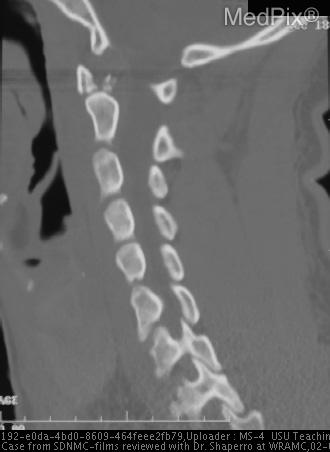
Multiple C1 fractures
- Image ID
- MPX2555_synpic14611
- Case U_id
- MPX2555
- Modality
- CT · CT - noncontrast
- Plane
- Sagittal
- Location
- Spine (Spine and Muscles)
- Age / Sex
- 21 / male
- Caption
- C-spine CT- multiple fractures on C1, bilateral posterior ring, right anterior ring. Fragmentation on right side of C1 into spinal canal, spinal cord intact. All other cervical vertebrae intact and without compromise.
- ACR Codes
- 3.4
Clinical case
- History
- 21 yo WM was entering the surf when a wave crashed directly on top of him. Patient was violently toppled over and struck his head on the sandy shore. Patient denies loss of consciousness or aspiration. He immediately felt bilateral paracervical neck pain upon impact on his head onto the shore. Patient emerged from the ocean under own strength and without any other complaints. He was promptly taken to the ED in ambulance without cervical spine precautions.
- Exam
- Tender to palpation over C1-C3, no neurological deficits. No other significant findings
- Findings
- C-spine CT- multiple fractures on C1, bilateral posterior ring, right anterior ring. Fragmentation on right side of C1 into spinal canal, spinal cord intact. All other cervical vertebrae intact and without compromise.
- Differential Diagnosis
- Multiple C1 fractures
- Case Diagnosis
- Multiple C1 fractures
Topic
- Category
- Trauma
- ACR Code
- -1.-1
Disease discussion
The need for surgical intervention for injury to the spinal column itself is dictated by the degree of deformity and the perceived stability of the injury. Displaced fractures of the cervical spine are usually treated with careful application of traction, using a halo or Gardner-Wells tongs. Weight is gradually added to the traction apparatus until the spine is realigned. The rule of thumb is that a weight of approximately 5 pounds per cervical level is required for reduction. The neurologic examination must be followed very closely as weight is added to the traction. Serial radiographs are used to determine when adequate reduction has been obtained. Inability to obtain adequate reduction is usually an indication for surgical intervention.Those injuries thought to be relatively stable or with instability in only one column can be managed with immobilization only. For significant fractures this involves the use of a halo brace in the cervical spine, and an orthosis, usually a molded jacket, in the thoracic and lumbar spine. Unstable injuries usually require surgical stabilization. Stabilization can be achieved by placement of hardware posteriorly, by use of hardware and bone grafting anteriorly, or in some cases using both techniques simultaneously. The anterior approach allows better access to the vertebral body and better decompression of the spinal canal. Three-column injuries generally require both anterior and posterior stabilization.The benefits of early spinal stabilization in patients with complete injury are primarily related to the prevention of complications of long-term immobilization. Data show fewer complications in patients whose spinal injuries are fixed early, although there are no compelling survival differences. Therefore, spinal column injuries should be fixed as early as practical, once the patient is physiologically stable and no longer at risk to suffer deterioration of neurologic function, either from exacerbation of brain injury or as a result of manipulation of the spinal cord.