Image
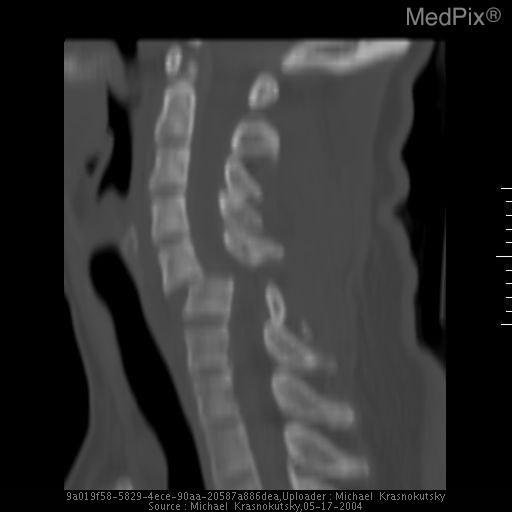
Bilateral jumped locked facets
- Image ID
- MPX2512_synpic19965
- Case U_id
- MPX2512
- Modality
- CT · CT - Montage
- Plane
- Sagittal
- Location
- Spine (Spine and Muscles)
- Age / Sex
- 33 / female
- Caption
- CT reconstructed sagittal plane of the cervical spine demonstrates bilateral locked facets at C5-6 level. The spinal canal is impinged and narrowed at the C5-6 level.
- ACR Codes
- 3.4
Clinical case
- History
- 33 year old woman was sitting on the trampoline while another person was bouncing on it. She was thrown into the air about 1 foot and was hyperflexed on landing.
- Findings
- More than 50% anterior subluxation of C5 on C6 with bilateral locked facets.
- Case Diagnosis
- Bilateral jumped locked facets
- Diagnosis By
- Radiologic Dx
Topic
- Category
- Trauma
- ACR Code
- 3.4
Disease discussion
Hyperflexion injuries are a common mechanism of injury of the cervical spine, accounting for up to 46% of cervical spinal injuries, and include a spectrum of radiographic abnormalities. The mechanism of the hyperflexion injury is usually a significant force directed against the occiput, forcing the face towards the chest, and resulting primarily in distraction of the posterior structures, with a lesser force vector resulting in compression of the anterior column. The spectrum of injuries ranges from the relatively stable “hyperflexion sprain” to the unstable flexion injuries (flexion teardrop fractures and bilateral locked/jumped facets).
The “hyperflexion sprain” is a ligamentous injury associated with varying degrees of disruption of the posterior ligaments (progressively involving the supraspinous ligaments, interspinous ligaments, facet joint capsules, and posterior longitudinal ligament, respectively), usually without associated fractures. These patients present with persistent pain, muscle spasms and, occasionally, mild reversible neurologic defects. Radiographic abnormalities, when they are present, include widening of the interspinous distance or posterior aspect of the apophyseal joints, and/or localized kyphotic angulation of the cervical spine.
Occasionally, a pure hyperflexion injury of the cervical spine completely spares the posterior ligaments and results only in osseous disruption of the anterior column, manifesting as either avulsion of the anterior portion of the superior vertebral ring (in the immature skeleton) or simple compression fractures of one or more vertebrae (in adults).
Another stable hyperflexion injury of the C-spine is the clay-shoveler’s fracture, an oblique fracture of one or more of the spinous processes of the sixth cervical through third thoracic vertebrae, from avulsion by the supraspinous ligament.
============== UNSTABLE INJURY ================
As previously mentioned, bilateral locked/jumped facets are one example of an unstable hyperflexion injury and result from rupture of the posterior portion of the annulus fibrosus, the posterior longitudinal ligament, and the capsular, interspinous, and supraspinous ligaments. Destabilization of the ligamentous support-structure of the spine allows such severe anterolisthesis of the cephalad portion of the cervical spinal column that facet locking occurs, with resultant severe narrowing of both the spinal canal and intervertebral neural foramina. Consequently, this injury pattern is invariably associated with neurologic deficits (75 percent of cases). The radiographic hallmark of bilateral jumped/locked facets is greater than 50% (half the width of the vertebral body) of anterior displacement of the superior vertebra, as demonstrated on the lateral radiograph. Associated osseous injuries include avulsion fractures of the spinous process above the locked level, and triangular fractures of the anterosuperior corner of the inferior vertebral body.
A second type of unstable hyperflexion C-spine injury is the flexion teardrop fracture, which typically results from the combination of flexion and axial loading. This injury manifests radiographically as an anteroinferior (teardrop) fracture fragment of a lower cervical vertebra (most commonly C5). The teardrop fragment may be large and frequently retains anatomic alignment with the adjacent inferior vertebral body or shows minimal anterior and downward displacement, while the larger posterior fragment shows posterior displacement relative to the vertebra below. Frequently, concomitant sagittal fractures through the vertebral body and laminae (associated with axial loading) are also present.
=============== ADDITIONAL PEARLS:
If the flexion force is associated with a rotational component, either a unilateral perched facet or a unilateral locked facet may result.. This category of C-spine injuries accounts for approximately 12% of the total.
The other C-spine hyperflexion injuries are: anterior subluxation, vertebral compression, flexion teardrop fracture, and spinous process (clay shoveler’s) fracture.