Інші зображення цього випадку
Image
SLAP Lesion of the Glenoid Labrum
- Image ID
- MPX1574_synpic16361
- Case U_id
- MPX1574
- Modality
- MR · MR - T1W w/Gd (fat suppressed)
- Plane
- Coronal
- Location
- Musculoskeletal (Spine and Muscles)
- Age / Sex
- 27 / male
- Caption
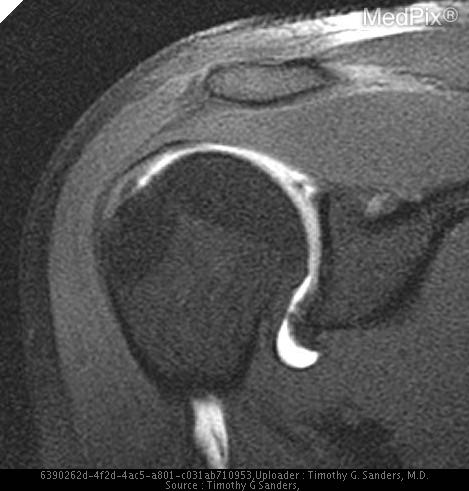
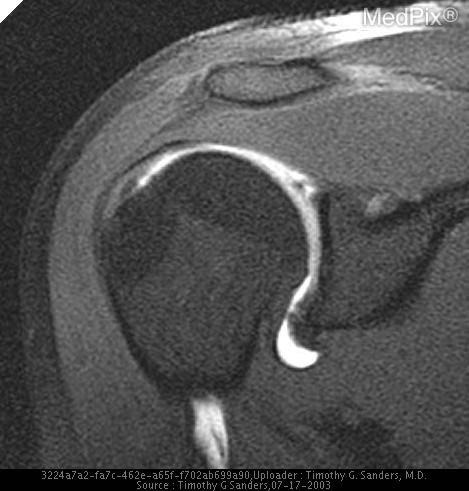
- Ti-weighted coronal image with fat-saturation demonstrates an irregular collection of contrast extending into the superior labrum.
- ACR Codes
- 4.4
Clinical case
- History
- Soft-ball player who complains of several months of right shoulder pain, aggravated by throwing the ball. No history of an acute injury.
- Exam
- No findings of shoulder instability on physical exam.
- Findings
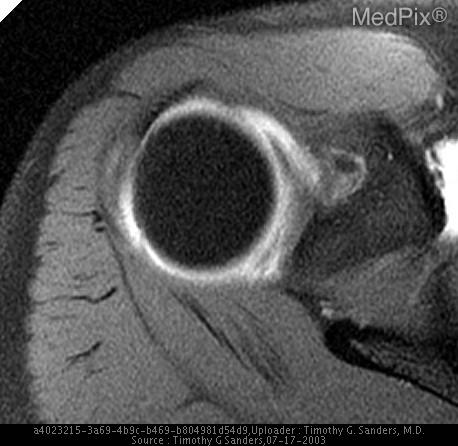
- T1-weighted axial and coronal images with fat-saturation of the shoulder following intra-articular administration of gadolinium. The coronal image demonstrates an irregular collection of contrast extending into the normally dark triangular appearing superior labrum. Axial image demonstrates an irregular collection of contrast between the frayed appearing posterior superior labrum and the posterior glenoid. The Biceps anchor appears normal.
- Differential Diagnosis
- SLAP lesion Sublabral foramen Sublabral recess
- Case Diagnosis
- SLAP Lesion of the Glenoid Labrum
Topic
- Category
- Trauma
- ACR Code
- 4.4
Disease discussion
SLAP stands for Superior Labrum from Anterior-to-Posterior, (relative to the biceps tendon anchor).
There are four types of SLAP tears. In type I lesions consist of a frayed and degenerative superior labrum with a normal biceps tendon anchor. Type II lesions demonstrate detachment of the superior labrum and biceps anchor and may also be associated with anterior glenohumeral joint dislocation and anterior instability. SLAP types I and II may be difficult to separate on MRI, depending on the technique used for diagnosis. Type III lesions involve a bucket-handle tear of the superior labrum (a vertical tear through a meniscoid-like superior labrum) without extension into the biceps tendon. The biceps anchor is stable and the remaining labrum is intact. Type IV lesions also involve a bucket-handle tear associated with a meniscoid-type superior labrum, but in this case with extension into the biceps tendon. The biceps anchor and the superior labrum are well attached. A partially torn biceps tendon may displace the superior labral flap into the joint. A complex SLAP lesion may consist of a combination of two or more types, usually type II and type IV.
Possible mechanisms of injury include a fall on the outstretched abducted arm with associated superior joint compression and a proximal subluxation force or a sudden contraction of the biceps tendon, which avulses the superior labrum. Repetitive stress acting through the biceps tendon or instability of the glenohumeral joint may also produce SLAP lesions.
Treatment of SLAP lesions is based on the type of labral lesion present. A type I SLAP lesion is treated with arthroscopic debridement of the degenerative labrum. Treatment of a type II SLAP lesion (which involves detachment of the superior labrum and biceps anchor) addresses the avulsed labrum and reattachment of the detached biceps anchor to the superior glenoid. A suture anchor technique, for example, may be used for a type II SLAP tear.