Image
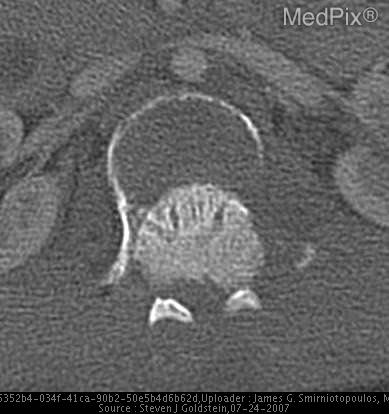
Fracture dislocation at thoraco-lumbar junction, resulting in spinal cord transection.
- Image ID
- MPX1506_synpic37594
- Case U_id
- MPX1506
- Modality
- CT · CT - noncontrast
- Plane
- Axial
- Location
- Spine (Spine and Muscles)
- Age / Sex
- 8 / male
- Caption
- CT shows two vertebral bodies, one far anterior, due to spinal column dislocation at the T12/L1 level.
- ACR Codes
- 3.4
Clinical case
- History
- 8 year old boy in MVA. Patient was in back seat wearing seatbelt.
- Exam
- • Paraplegia • Multiple extremity injuries
- Findings
- • CT: - Fracture dislocation of spine at T12/L1 • MRI: - (Post-reduction) Spinal cord transection with intraaxial hemorrhage and spinal cord edema
- Differential Diagnosis
- None
- Case Diagnosis
- Fracture dislocation at thoraco-lumbar junction, resulting in spinal cord transection.
- Diagnosis By
- CT and MRI
Topic
- Category
- Trauma
- ACR Code
- 3.4
Disease discussion
Diagnostic imaging of acute spinal trauma has and will continue to rely upon plain film and CT examination (1). However, none of these modalities can assess the cord directly and its relationship to the surrounding structures. The introduction of MR compatible hardware for spine stabilization and modification of life support devices for use in MR scanning has made imaging of the acutely injured spine possible. Cord edema and hemorrhage are frequently seen in the acutely traumatized spinal cord. Cord edema can cause focal enlargement of the cord, but more frequently elongates T1/T2 due to the water content. This is usually best seen on T2-weighted images as an area of increased signal. Clinically, it may be important to distinguish an edematous cord from a hemorrhagic contusion (3). Cord hemorrhages evolve similarly to intracerebral hemorrhage, and therefore acute hemorrhages tend to have low T1 and T2 signal characteristics. On the T2-weighted sequences, the hemorrhagic low signal portion is often surrounded by a ring of high signal intensity edema. Finally, cord maceration and transection represent the most severe form of cord injury. This is usually seen as a loss of cord signal or marked inhomogenity of signal where the cord should be. In this particular case, the thoracolumbar junction acts as a fulcrum, tending to produce flexion-compression (i.e., burst) fractures, with motion instability and a tendency to produce retropulsion of the fracture fragment.