Інші зображення цього випадку
Image
Orbit "blow-out" fracture
- Image ID
- MPX1386_synpic38161
- Case U_id
- MPX1386
- Modality
- CT · CT - noncontrast
- Plane
- Coronal
- Location
- Eye and Orbit (Head)
- Age / Sex
- 51 / male
- Caption
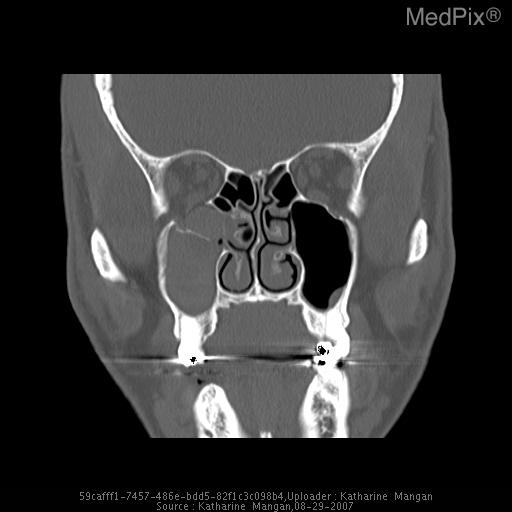
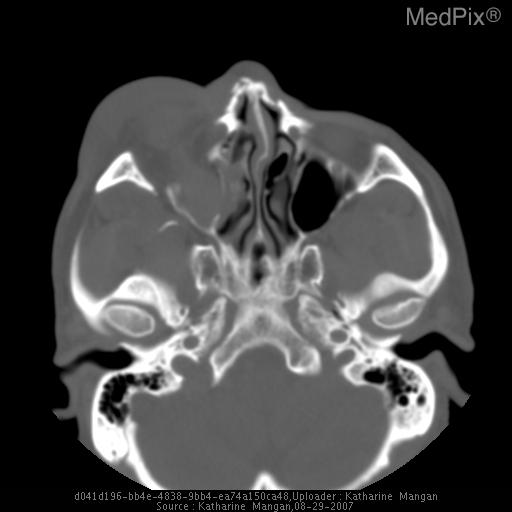
- Coronal image with bone technique demonstrating fracture through inferior orbit displaced inferiorly with soft tissue swelling and maxillary sinus opacified with blood.
- ACR Codes
- 2.4
Clinical case
- History
- 51 y/o male with trauma to face.
- Exam
- Facial edema.
- Findings
- • inferior orbit fracture • soft tissue swelling • bleeding into maxillary sinus
- Differential Diagnosis
- Given the history, there is no other differential in this case. The soft tissue swelling, fluid in the maxillary sinus, and trap-door appearance of the inferior orbital wall are the classic appearance of an inferior orbital wall blow out fracture. Other etiologies of disruption of the inferior orbital wall would include neoplasm, resection, and aggressive infection.
- Case Diagnosis
- Orbit "blow-out" fracture
- Diagnosis By
- CT
Topic
- Category
- Trauma
- ACR Code
- 221.414
Disease discussion
When an object of large diameter (greater than 4-5 cm) like a fist or a baseball, strikes the orbit, forces may be transmitted through increased intra-orbital pressure. When there is increased pressure in the orbit, the thinnest bones break first, and the orbital contents may herniate through the fracture. This is the so-called "Blow-out Fracture". Typically, the floor of the orbit, parts of the medial wall (lamina papyracea) and rarely the orbital roof may "blowout".
Clinical signs of entrapment (abnormal EOM's with restricted upward gaze) and enophthalmos (retraction of the eyeball) may occur.
Complications of Blow-Out Fx:
Pneumo-orbita
Cellulitis and Abscess
Diplopia and Restricted EOM's
Blunt force trauma (e.g. Ball or fist)
Hydraulic (pressure) forces increased intra-orbital pressure
Fractures thin bones
Floor (orbital process of maxilla)
Medial (20-50%) (lacrimal and ethmoid)
Herniation and entrapment of orbital fat & EOM (inf. Oblique)
The literature continues to emphasize this "Hydraulic Theory" over the alternative hypothesis of direct transmission of forces from the orbital rim and/or the globe itself.
http://www.ncbi.nlm.nih.gov/entrez/query.fcgi?cmd=Retrieve&db=pubmed&dopt=Abstract&list_uids=12020203&query_hl=4&itool=pubmed_docsum