Інші зображення цього випадку
Image
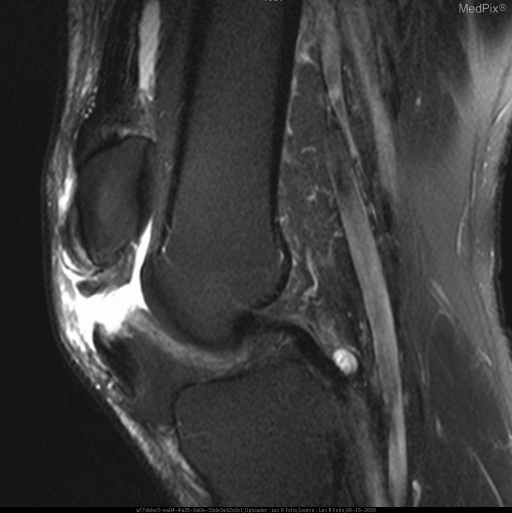
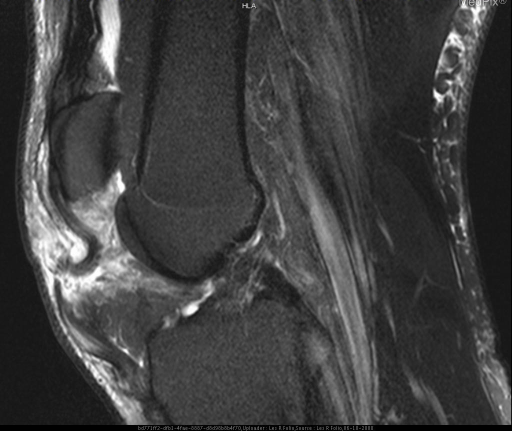
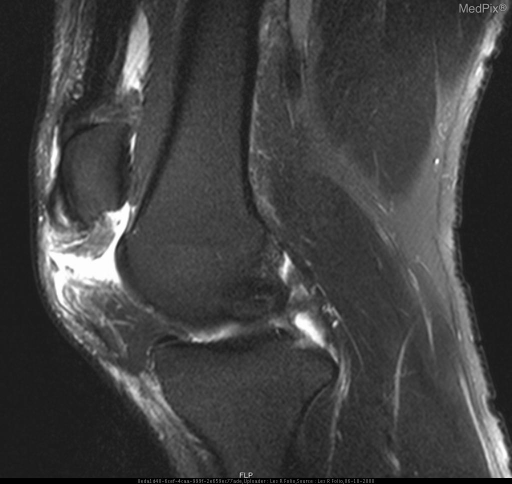
Disruption and tears of the patella tendons bilaterally.
- Image ID
- MPX1260_synpic43422
- Case U_id
- MPX1260
- Modality
- MR · MR - T2 weighted
- Plane
- Sagittal
- Location
- Musculoskeletal (Spine and Muscles)
- Age / Sex
- 42 / male
- Caption
- Figure 4 is a T2 sagittal of oppisite (left) knee showing the tendon retracted with associated with wide gap of increased signal representing tear and inflammation.
- ACR Codes
- 4.-1
Clinical case
- History
- This 42 y/o active duty man jumped from his vehicle and felt a pop. He then tried to hop on the other leg to the aid station and felt a pop in the good leg. The rest is history with him lying in the dirt unable to walk, asking for help, crawling on his belly, etc.
- Exam
- Swelling of patellar tendons and high riding patella bilaterally.
- Findings
- Plain lateral x-rays of bilateral knees showed patella alta, a high riding patella. Joint effusion was noted. On MRI, disrupted patellar tendons were noted bilaterally.
- Differential Diagnosis
- • Trauma due to extreme combat conditions (body armor, heat, stress). • Systemic lupus erythematosus • Rheumatoid arthritis • Steroid use/ abuse
- Case Diagnosis
- Disruption and tears of the patella tendons bilaterally.
- Diagnosis By
- Plain CR and MRI
Topic
- Category
- Trauma
- ACR Code
- 4.4
Disease discussion
Avulsion injuries of the patella tendon are associated with tendonopathy or “jumper’s knee.” Patella tendonopathy is an overuse syndrome that comes from a variety of exercises to include jumping, kicking, or running. Histologically, patella tendonopathy is not an inflammatory response, but a mechanical failure of the patella tendon fibers with resultant mucoid degeneration and fibrinoid necrosis. The tendon will thicken near its insertion at the inferior pole of the patella. The is the predisposing factor to tendon disruption.
Partial avulsions of the patella tendon typically involve proximal fibers. Associated findings include, tendon thickening, soft tissue edema, and involvement of Hoffa’s fat pad. Treatment is conservative for a partial rupture of the patella tendon with physical rehabilitation. Surgery is indicated if there is a complete rupture.