Інші зображення цього випадку
Image
Bizarre Parosteal Osteochondromatous Proliferation
- Image ID
- MPX1243_synpic24673
- Case U_id
- MPX1243
- Modality
- CT · CT - noncontrast
- Plane
- Coronal
- Location
- Musculoskeletal (Spine and Muscles)
- Age / Sex
- 0 / N/A
- Caption
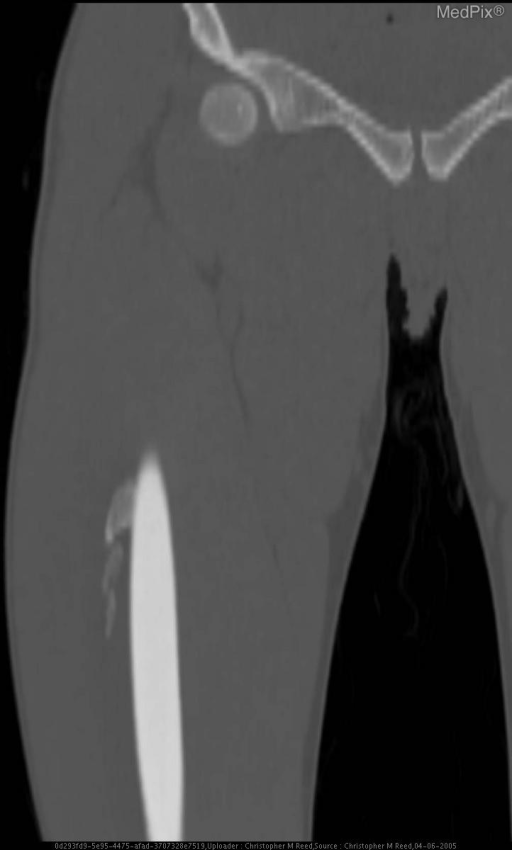
- Cortically based calcification extends toward adjacent myositis ossificans, without medullary contiguity. There is no cortical destruction.
- ACR Codes
- 4.4
Clinical case
- History
- 24 year old male with history of blunt trauma to right thigh, presents with palpable soft tissue mass at site of injury.
- Exam
- Physical exam demonstrates firm soft tissue mass with poorly defined margins at the medial right thigh. No history of fevers, chills or unexplained weight loss. Normal neuromuscular examination.
- Findings
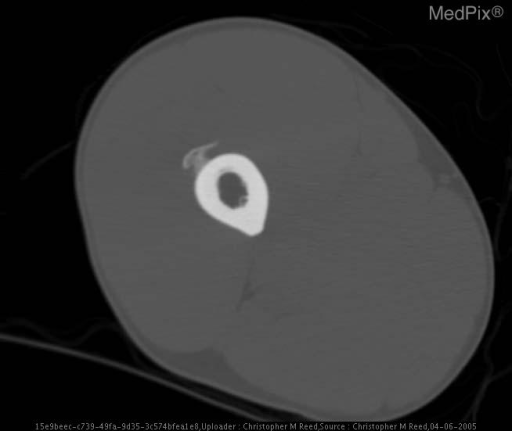
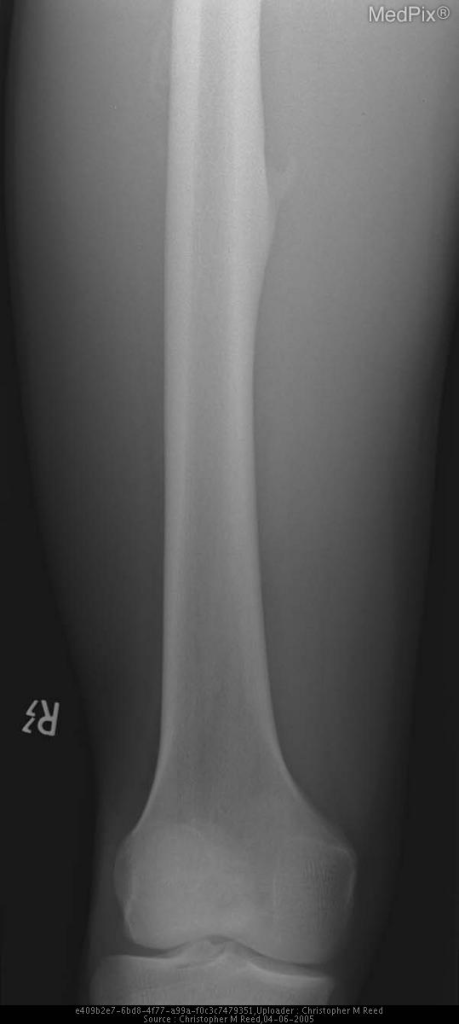
- Irregular soft tissue calcification is seen adjacent to the lateral aspect of the mid right femur, underlying site of known prior trauma and now-palpable soft tissue mass. Cortical contiguity is uncertain. Additionally, there is curvilinear extension of the posteromedial mid right femoral cortex consistent with a chronic tug lesion of the thigh adductors.
- Differential Diagnosis
- Bizarre Parosteal Osteochondromatous Proliferation / Myositis Ossificans Florid Reactive Periostitis Osteochondroma Parosteal Osteosarcoma Ewings Sarcoma
- Case Diagnosis
- Bizarre Parosteal Osteochondromatous Proliferation
- Diagnosis By
- Combination of clinical and radiographic findings.
Topic
- Category
- Trauma
- ACR Code
- 4.4
Disease discussion
Bizarre Parosteal Osteochondromatous Proliferation (BPOP) is a rare benign lesion in which heterotopic bone arises from otherwise normal periosteum. BPOP most commonly results after minor trauma to tubular and long bones which results in myositis ossificans in closely adjacent soft tissues being incorporated into the underlying periosteum. The theory of this continuum is supported by the report by Ly JQ et al. entitled “Radiologic demonstration of temporal development of bizarre parosteal osteochondromatous proliferation” in which the natural course of blunt trauma was followed from soft tissue edema through myositis ossificans to BPOP over the course of a year. There should be no periosteal reaction aside from the parosteal osteochondromatous proliferation and importantly no associated cortical or medullary involvement or associated soft tissue mass. Absence of cortical or permeative bone destruction excludes neoplastic etiologies while absence of medullary extension excludes the more common benign osteochondroma.
Surgical resection may be sought in symptomatic patients; however, when surgery is contemplated, bone scan must be performed prior to surgery. Recurrence typically occurs in lesions that have increased uptake on nuclear medicine bone scan.